By Arthur AKA (AAKVIPER)

Tuesday, June 15, 2010

A 1675 with the very rare and sought after all blue and all copper insert.


The insert numbers are a real silver and not faded to a light gold color as most early inserts become. Compare the all blue 1675 GMT insert numbers to the all copper GMT insert.


The early all gold inserts had fat number fonts..Compare the number "8" for example on the all gold faded 1675 with the copper insert.
Now as far as the silver color, the early fonts in the picture are more of a light gold cream from fade. But copper is a real no fade silver and is an entirely a different insert when one looks closer. The serifs are different as well on the two inserts, as one can see for example in the number "4".

The all copper insert has the number fonts in silver not gold..BIG differance..same as the all blue bezel. These 1675 GMT inserts I believe were used in the late 1960's and 1970's on the two tone model 1675 gold bezel and SS cases. But maybe also found on just an all SS 1675 GMT.


The all blue GMT insert from my research was issued on military 1675's at first..

But with surplus the leftover all blue bezels were given to Rolex service centers and made available as an option to service customers in the 1970's till the stock ran out. I was also told by Rolex NYC that the service center watchmaker years ago when I submitted my 1675 for service, that an in-house parts book had the all blue Tudor Sub and Rolex GMT bezel pictured. One interesting note, was that Tudor had an all blue bezel on the 1970 Tudor Sub and Monte Carlo chrono model.


One can also find GMT inserts in purple

Monday, March 22, 2010

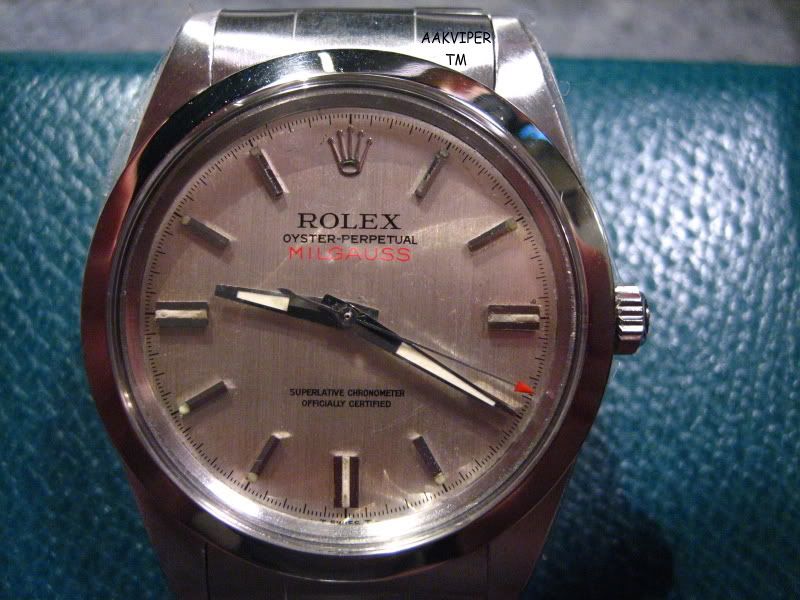
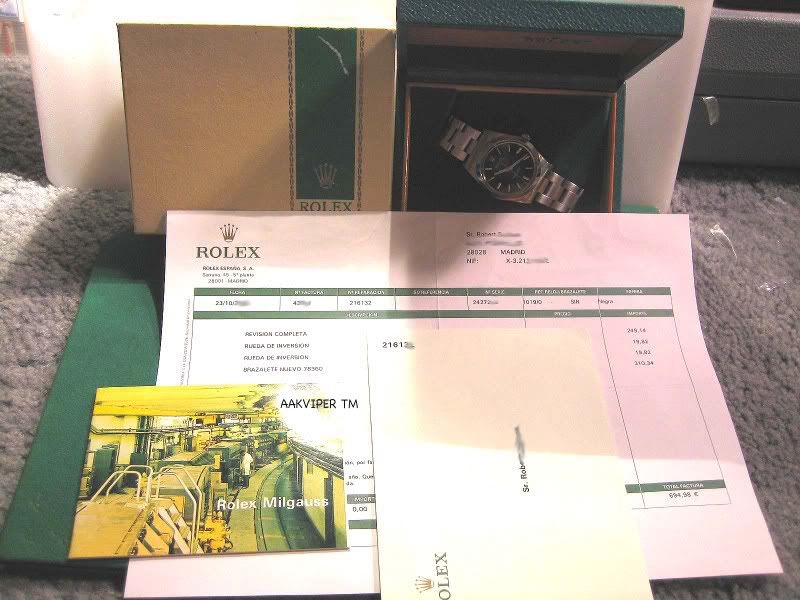
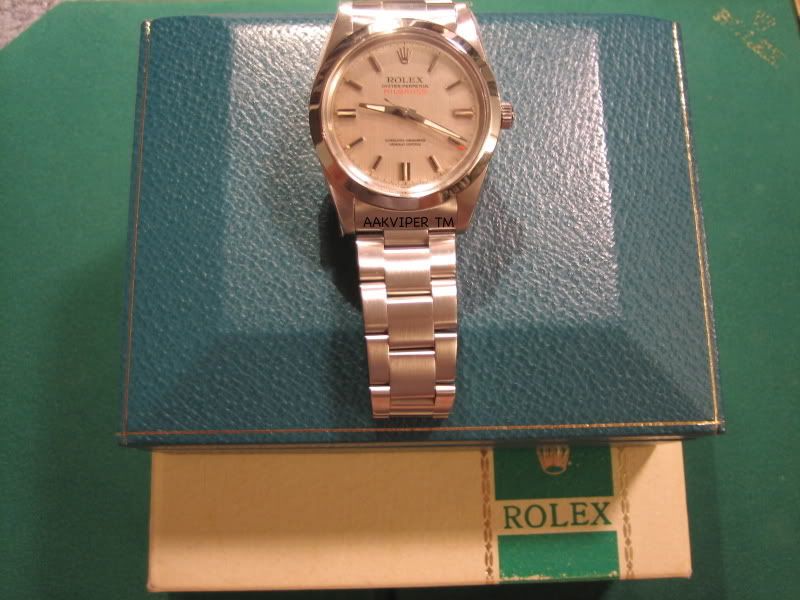
The look at unique Milgauss 1019


The Milgauss 1019 Rolex is a very unique watch.
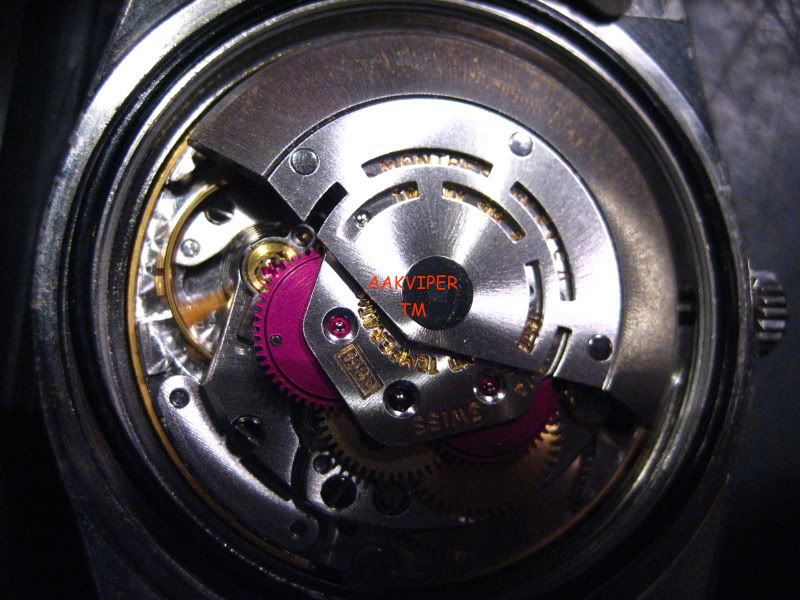
Used by professionals working in highly magnetic atmospheres such as in nuclear industries which yielded a strong magnetic fields. A need came about to have a watch movement be able to handle these extreme conditions. Rolex was up to the challenge and created a iron cage to house and shield the caliber from any magnetic harm.
A simple synopses of this model revels to us that only two dials were ever issued for this reference. A silver and black dial was the only chosen options a buyer had on this model.

The early models had the 1/5 hash markers on the dial, while later dials were changed over to a 1/2 hash markers. This dial is the rail dial version..Very rare to find a 1019 rail dial.


1/2 hash markers


1/2 hash markers


A picture of a rail and non rail 1019 dail.


rail dials


The 1019 featured two types of minute and hour hands. The early 1019 hands featured a gloss polished hour and minute hand built out of an antimagnetic material. The later hands had an aluminum matte textured hour and minute hand. Oddly enough the 1019 straight second hand with a red arrow tip and apparently been used on the early and later 1019 model run.

Three odd items which intrigued me were, the fact that the reference 1019 used a small 5.3 mm rather then the bigger 6.mm crown. As well as the large tropic # 32 crystal. One of the largest plastic Rolex diameter crystal in the Rolex family. I believe this case design housed the movement top iron plate and resulted in a bigger crystal to cover the extra case size. The last odd fact about the 1019 transpired in the "M" letter being stamped on the caliber plate, only found on the 1019 caliber.


The 1019 rotor bridge had a specific 1580 stamp instead of the ubiquitous 1570 numbers.


One other notion regarding the 1019 dial variations, a rail 1019 dial does exist and is correct. See the comparison of a rail 1665 and 16550 to the 1019 rail dial in the picture below. Same font alignment and layout. No disputing this fact that the 1019 rail dial exists.

Sunday, November 1, 2009

Some particulars about the double silver print variation 5508 dial.

A brief background on the thin cased 5508 non crown guard seems to be in order. The 5508 Submariner replaced the similar in appearance 6536 and 6536-1 with 1030 caliber. But for a short time these thin cased models were produced at the same time. A ball park production figure for the 5508 Submariner would be from late 1957 to 62. The foremost advantage which the 5508 model shared over the 6536 examples was that it housed the updated 1530 caliber. For a collector or watchmaker this 1530 caliber made it easier to maintain then the harder to find 1030 caliber parts.


The topic for this segment, will be about a very early chocolate color dial change 5508 model.

From my research this double silver rounded bottom coronet 5508 dial was a particularly an early one. I am not unfamiliar to this type of dial. I also owned an early 6536 thicker cased 1030 caliber Submariner with this style of dial. Being an early thicker cased 6536 with this type of rounded crown and double silver print dial made me wonder if at that time I had an early variant. Unfortunately, I sold the 6536 almost nine years ago not understanding rarity of this dial.

Being a low and early production dial I have seen a few more similar dial coronet configuration in my travels, one on an early 6542 GMT and a couple other early 5508 Subs. The 6542 and 5508's bore early serial # as well. All these models so far had sub 38xxxx serial numbers. Logically from what I have observed, this early 5508 two silver line dial was placed in early Sport's models for a few short years.


The early two silver line dial model (361xxx) serial has the very popular and desirable color change dial feature as well. It has turned to a nice medium chocolate color.


I will be focusing on a particularly early serial 361xxx non crown guard Submariner model. This 5508 SWISS gilt gloss dial with double silver print dial rounded bottom coronate, is quite a rare variation in the 5508 dial line up. See picture below for the dial coronate variation.

One will notice the more rounded dial coronate bottom and longer crown arms. The gold print fonts such as letters "R" non serif and "O" are unique on this 5508 variation


This depiction below is a dial coronate from the more ubiquitous 5508 dial with a flatter crown bottom and a lower crown arm ends. The letters "R" with serif and "O" are with gold print as well.

In the photo below we see the depth rating and the word Submariner both in sliver print, instead of the gold and sliver combination.


This feature of having silver print on these fonts are not common to 5508 dials. Below in the photo we see the more common SWISS dialed 5508 with a silver depth rating and gold Submariner font.


Saturday, October 24, 2009

The matte dialed 5513

This post is a small summary regarding the 5513 round crown guard model for now, and not an in depth perspective of the 5513 model. I will omit the military, double named dials, and other special versions of the matte 5513 model. I will add more info on these adaptations as time passes.

The Rolex non date Submariner is arguable the one of the most iconic Rolex model in the world. But for most Submariner vintage collectors their first vintage purchase was a 5513 non date round guard Submariner model. The term round crown guard originates from the crown guard basically being round at the top area near the crown seat, rather then ending up in a point or peck as on the first version of 5513 cases.


The more affordable examples from the 5513 model line are the matte dialed round crown guard versions appearing towards the mid 1960's. This was a transition period from the gloss gold gilt dial era to the matte versions.

The first and more desirable matte dial version was the 200m/660ft version (1965-71), then followed by the more generic and ubiquitous 660ft/200m dial. As with many Rolex dials the 200m/660ft and 660ft/200m dials were being produced at same time for a few years. The final years of the 5513 production run housed a gloss dial with gold makers.

The calibers used for the 5513 were the 1530 and 1520. The slow beat (non submitted for chronometer testing) 1530 caliber ironically was shared with in the early 1960's with the 5512 Submariner, then around 1964-65 the a non hacking 1520 caliber transitioned onto the scene. From my research the non hacking 1520 caliber was made only a few short years before being replaced by the hacking 1520 caliber around 1967-8 or so. The hacking 1520 caliber would remain the caliber for the 5513 till the end of production well into the 1980's.

An early 200m/660ft dail matte version of the 5513


I do own a 660ft/200m dial in a military format


a view of the case back and 1520 caliber.


Here we have a Swiss gloss gilt dialed 5513 pointed guard from 1963 equipped with a 1530 caliber. More on the early 5513 in a few weeks.

The Submariner reference # 5512

Before we commence our review of te 5512 model. I would like to point out the rare 5512 circa 1959 with the rare early 1st gen Swiss outer chapter ghost coronet silver and gold gilt font four line dialed early 1 generation watches. This early swiss type of dial does not have the usual flat coronet found on later 2 gen Swiss outer chapter ring dials. The seperation between the four lines, top two being of gold gilt, and the bottom two of silver gilt print is unique to this dial. Below we have two early Subs one being an early 5508 with ghost face coronet dial and the other an eraly 5512 with the same type of dial. This type of coronet was so named because it resembles a ghost face.
The thicker case is based on the square guard first gen 5512 with non chronometer rated two line dial. A very rare transitional 5512 is and an important part of the Sub's evolution. I just love the 5512, and wear everyone in my watch rotation. My favorites are the gold gilt gloss dialed editions.

Pointed or with the round crown guard, as long as it is a 5512 it gets my attention.
I love the look of the dial and the very accurate 1530, 1560, and 1570 calibers.
What I found to be very interesting to me was, that the 5512 was a truly small production model by Rolex.

I have always ascertained that the 5512 was a hard model to sell to customers. I say this because it looks almost exactly as the less expensive 5513 to the eyes of a new customer in that era. I bet it was hard to justify the extra cost from upgrading from a 5513 to the 5512 to the perspective client

The sales pitch must have been difficult to administer, two extra lines on the dial and a more precise caliber seems like a hard sell to me.

But apparently customers agreed with my assessment, and my belief was that the 5513 outsold the 5512 (unofficially) 5 to 1.

Be as it may, unpopular models are sought after by collectors. The 1019, 1655, and 1530 to name a few have a large following.

Some of my 5512 collection below.


The pointed guard gloss "SWISS" four line gold and white print 5512 is in my opinion the must desirable 5512's to collect.


What I observed was that a similar gloss gold gilt print dial was also in the line up. The gloss gold print Swiss-T< 25 with gold and white dial print. Believe it or not from what I have reserched on this dial, it is less commonly found then thought. It may be as rare as it's Gloss Swiss brother. I say this because I have seen far less numbers Swiss- T<25 1560="" 1963="" 1966="" 5512="" and="" as="" at="" auctions="" between="" both="" caliber.="" collectors.="" crown="" dealers="" dials.="" dials="" experances="" fall="" found="" from="" gloss="" guard="" in="" just="" my="" obervation="" of="" other="" ownership="" pointed="" production="" range="" research="" rolex="" rounded="" s.="" shows="" strong="" swiss-="" swiss="" t="" the="" these="" to="" vintage="" watch="" watches="" where="" with="" years="">The 5512 'Bart Simpson' coronet dialed Sub was produced between the years 1965 to maybe 1967.
Some collectors say the start date to be 1964. But maybe to early, at lest for me.
Small production run for only two to three years or so.
They can be found in pointed and round guard cases and on 5512-3 dials so far.
I have not seen any Bart coronet GMT or 1016 dials yet.
I believe they are more collectable because of the limited run. These Bart dials also have a tendency to turn brown with the right or should I say bad environment of humidly case leakage.


Let us take a glance at the first pointed guard 5512 case.


Besides the first 5512 square crown guard, I believe the second desirable case to collect would be the first generation 5512 pointed crown guard variant. From my research not all early 5512 crown guards have the same shape. The early release 1959 or so 5512's had a more define side angled peak to the crown guard shape. I noticed even back in the day on my early 5512 which I purchased ten years ago that this crown guard was not a run of the mill pointed guard. But back then when vintage Rolex was not mainstream yet, I did not have the research tools and other examples from other collectors or from dealers to put this puzzle together.

When one compares the second generation 5512 pointed crown guard case to the first generation, one can see in my opinion a lack of defined sharper side peak side area. It also appears to me that the second generation crown guard sticks out a little farther in covering the side crown field area. While the first generation crown guard comes at a steeper angle and sticks out less.


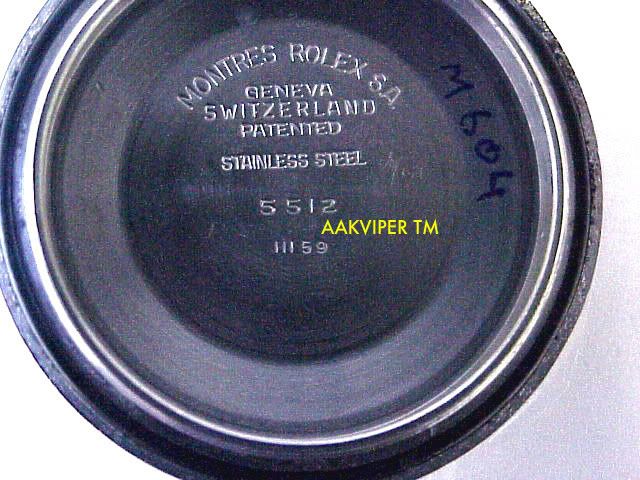
The first generation pointed guard 5512 case with this unique crown guard shape seems to have been produced around the 5xxxxx range with possibly only III 59 case backs. As with very early 5512's, the reference and serial numbers were placed at the top of the middle case area unlike the latter bottom number case placement.


I have only seen a small amount of this 5512 crown guard variation over time by way of collectors and watch dealers. Unfortunately many of these early 5512's had bad case polishes and the definition was not as crisp as it once was.
Recently I noticed an expose about the early 5512 square and first generation crown guard in the 2009 Italian watch magazine named OM.

I conducted a comparison photo of my early 5512 to the 5512 picture displayed in the magazine article.


One conjecture that really caught my attention was that allegedly a few early square guard 5512 were filled down to a pointed configuration to make it easier for divers to set the crown. Could this explain the sharp angles of the first generation pointed guard?


Be as it may, I found the early 5512 case crown guard research interesting and on going, while the OM magazine is NOT a Rolex factory resource verification tool. This article did add some new perspective of why maybe we have different 5512 case shapes over the years. OM is a pleasure reading magazine so take what is written in perspective, as many articles are just conjecture of people think and not 100% correct.

It appears that the early 5512 case design was truly unique..
Istacked a 1963 5512 over my 1959 5512. Looks to me that the lug on the 1959 case (bottom one) is thicker then the 5512 1963 top case lug. Also notice the more prominent curve on the 1959 case lug. The 1963 has more of a slant to it.
See the photo blow..interesting perspective on case design evolution.


About Me

United States
Check out the Watch Talk Forum http://www.watchtalkforums.info/forums/vintage-rolex-forum/ /Also check out / http://rolexblog.blogspot.com/2012/03/sean-connery-ursula-andress-set-of.html